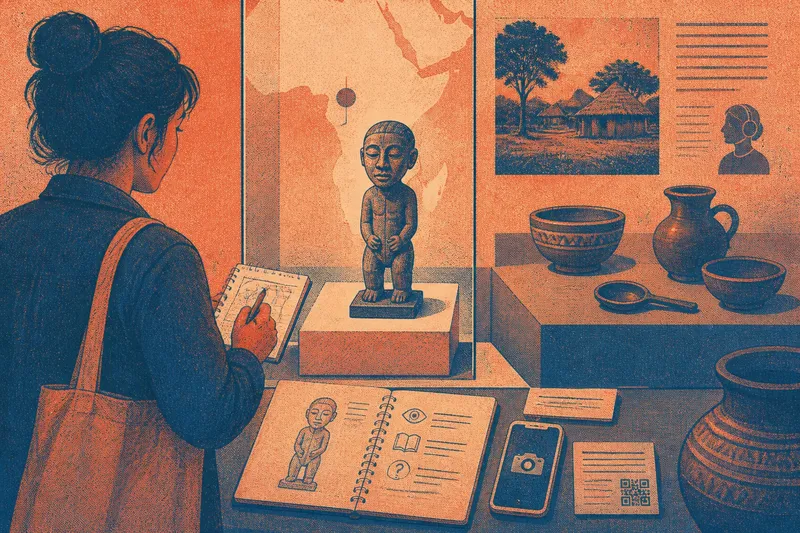
The Single-Origin Story: Why Objects Rarely Have One Cultural Address
Describe an object’s cultural origins more accurately by separating its materials, making, manufacture and later uses instead of forcing them into one place name.
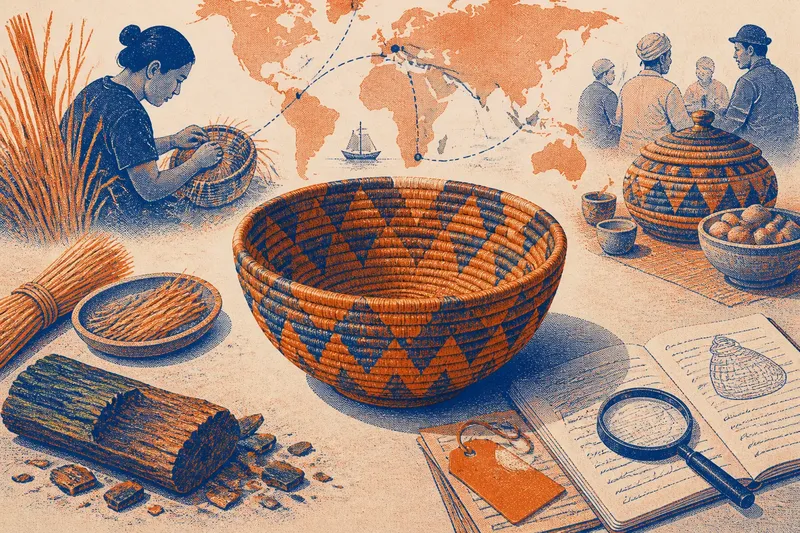
The common mistake in writing an object caption is to give it one cultural address: a country, community or workshop supposedly explains the whole thing. The single-origin story is neat, memorable and often wrong in ways that erase the people who supplied its materials, shaped its form or gave it later meaning. A better account of an object’s cultural origins starts by separating those claims.
Material, technique, manufacture and use are related questions, but they are not interchangeable. Decide which one the evidence answers before choosing a place name. That keeps a complicated history from becoming a tidy souvenir slogan.
What does “origin” mean for this object?
Start by deciding which part of the object you are describing. “Made in” may refer to the place of assembly; “made by” to a person, workshop or community; “made from” to materials with their own sources. “Used by” and “understood as” concern later lives, which may unfold somewhere else entirely.
An object can therefore have several defensible origins, each answering a different question. A carved wooden bowl might use timber gathered in one region, a carving practice taught within a particular community, and a form adapted for trade elsewhere. Calling the bowl simply “from” one place leaves the reader guessing which claim you mean.
For a caption, collection note or family account, write down the claim in plain language before choosing a place name. If the claim is “the timber came from this region”, do not let it quietly become “the bowl belongs to this region”. The narrower sentence is not timid. It is just doing less damage.
When should you start with the material?
Choose the material route when the object’s substance is documented more clearly than its maker or use. Traded materials such as shell, metal, timber, fibre, stone and pigments may travel far from where an object is assembled. A material’s source can explain access, exchange or technical choices, but it does not by itself establish the maker’s identity.
Look for visible clues and records that identify the material, then distinguish those clues from proof of geographical source. A dark surface might suggest a particular wood to an informed observer, but appearance alone cannot settle where it grew. Labels, conservation records and specialist identification may help; if they do not specify provenance, keep the claim at the level they support.
Say you are describing a woven basket whose plant fibre is identified, while the maker and place of weaving are unknown. You can state what fibre it uses and mention a documented regional association without assigning the basket itself to that region. The result is a caption that preserves what is known without inventing a maker.
When is technique a better clue?
Choose technique when the construction is distinctive and evidence connects the method with particular practitioners or teaching traditions. Joining, firing, weaving, casting and carving can carry knowledge across generations and borders. A technique may travel through apprenticeship, migration, commerce or copying, so its presence is a clue to a connection, not an automatic passport stamp.
Separate the method from the people who used it. “Made using a coiling technique associated with…” differs from “made by…” and from “invented in…”. The first describes a construction feature and its documented association; the others make claims about authorship or historical priority. Use stronger wording only when the evidence supports it.
Ask whether the method could have been taught or adapted beyond the place where it is best documented. If so, describe the connection rather than treating the technique as exclusive property. This recognises knowledge without pretending it stayed still.
When should you focus on later use?
Choose use when an object’s meaning changed as it moved between people or settings. A container made for storage might later serve as a ceremonial object; a tool could become a household heirloom or a museum display. The later role is part of the object’s history, but it should not be projected backwards onto its original purpose without evidence.
Describe the stages separately: what the object appears designed to do, who is documented using it, and what it came to signify later. Where the record is uncertain, say “later used as” only if that use is known. “Traditional object” is no substitute for naming a community, context or period; the phrase can make change disappear beneath a pleasantly vague label.
A treasured serving dish may have acquired meaning through repeated use, inheritance and changes in household life. That history can be culturally significant without proving that the dish was originally made for the role it now holds.
What should you say when evidence is thin?
Choose a restrained description when records are incomplete, conflicting or silent. Begin with observable details: material, construction, marks, condition and any documented ownership or transfer. Then state what remains unknown. “The maker and place of manufacture are not recorded” is useful information, not an invitation to guess.
Check the object itself, its label and any available catalogue or family documentation. Keep an inherited label’s wording distinct from a verified fact, especially if it uses broad terms such as “tribal”, “oriental” or “native”. Such terms can flatten differences between communities and may reflect the habits of whoever catalogued an object rather than the people who made or used it.
If a claim concerns cultural ownership, restricted knowledge or a community’s authority over an object, a general description may not be enough. Seek guidance from an appropriate community representative or qualified specialist where that matters. For ordinary descriptive writing, uncertainty can be stated plainly without turning every caption into a research project.
Which questions help separate an object’s origins?
What if the object was assembled in one place from imported materials?
Name the place of assembly and the known material sources separately. This tells readers where the object took shape without implying that all its components originated there.
What if a technique is shared across communities?
Describe the technique and name the communities or traditions it is associated with where that association is documented. Avoid presenting a shared practice as exclusive unless the evidence supports that claim.
What if the object’s current meaning differs from its first use?
Describe the known earlier function and the later use as separate stages. If the original purpose is uncertain, say so rather than treating the present meaning as proof of the past.
What if a catalogue gives only one place name?
Use the catalogue’s attribution as an attribution, not necessarily as a complete account. If possible, identify what the place name refers to—maker, manufacture, collection or use—and leave the other parts open.
How can you make the wording more exact?
Use five evidence lines: material, technique, manufacture, use and uncertainty. Leave a line blank when you do not know the answer. Then build the sentence around the best-supported claim and add other documented connections only when they clarify the object’s history.
- Material: Check what the object is made from and whether its source is documented. If both are known, state them separately; if only the material is known, name it without assigning a source.
- Technique: Check which construction or making method is visible or recorded. If a documented association exists, describe it as an association; if not, describe the method without naming a tradition.
- Manufacture: Check whether the place of making and the maker are recorded. If both are known, identify them; if only the place is known, name the place and leave the maker unidentified.
- Use: Check who used the object and for what purpose at each documented stage. If its purpose changed, describe the stages separately; if only a later use is known, do not present it as the original one.
- Uncertainty: Check which claims are inferred, attributed or unknown. If a claim is attributed to a catalogue or inherited label, say so; if it cannot be traced, omit it or state that it is unrecorded.
Imagine a caption writer has an invented brass vessel, a record identifying its coastal workshop, an entry saying the metal was imported, and a family note that it was later used in household ceremonies. The writer checks each source, records manufacture, material and later use on separate evidence lines, and leaves the maker’s name blank because none is supplied. The resulting caption could read: “A brass vessel made in a coastal workshop from imported metal, later used in household ceremonies; the maker is unrecorded.” Readers can see which claims the records support and where the account stops.
The single-origin story is tempting because it fits neatly on a label. Resist it when the evidence points to several kinds of connection. To describe an object’s cultural origins clearly, name what travelled, what was made where, and how people later used or understood it. A place name should answer a question, not conceal that there were several.