How Tea Became More Than a Drink at the Table
Tea service changes with the room, host and occasion. Learn to read its social signals without mistaking one household’s custom for a universal rule.
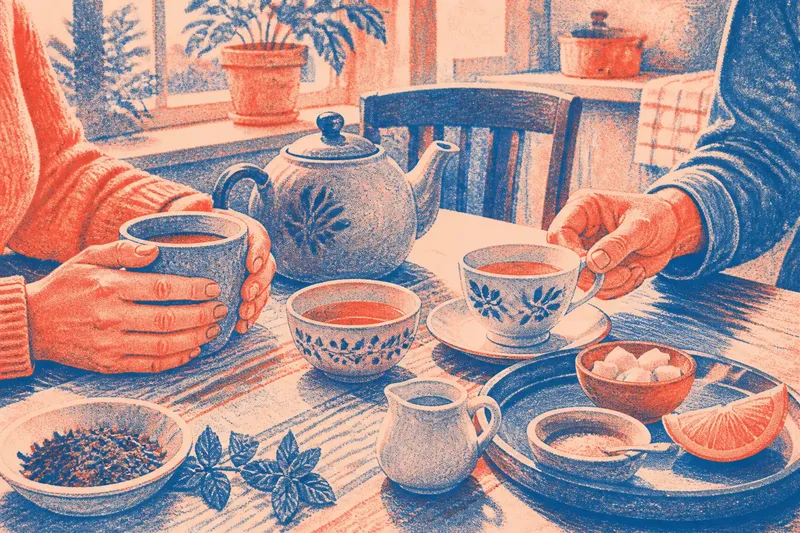
The common mistake with tea service is to treat the cup as the whole event. That can cost a guest the chance to read what the host is offering: refreshment, welcome, a pause, or a reason to sit together. Tea service is not a single ritual exported intact; it is a set of social habits communities adapt to their rooms, schedules and ideas of hospitality.
How does an offer of tea welcome a guest?
In many settings, offering tea is a small act of welcome. The drink matters, but so does the pause required to prepare or accept it. A host who asks whether a visitor would like tea makes room for a brief exchange before the practical business of a visit begins. The answer may be yes, no, or a preference for another drink; the courtesy lies in the offer, not in making the guest comply.
The form of that welcome varies. Tea may arrive on a tray, be poured at the table, or be served in a working kitchen while conversation continues. A carefully arranged cup and saucer can signal attention to presentation, while a mug beside a kettle may indicate that the visit is meant to feel unceremonious.
It is easy to mistake a familiar gesture for a universal one. In some households, accepting a drink is an expected part of hospitality; elsewhere, a quick offer and a gracious refusal are ordinary. A visitor can follow the host’s pace, ask what is customary, and avoid treating the ritual as a test with one correct answer.
What does the vessel say about the occasion?
Tea’s social role is shaped by what holds it. A cup, glass, bowl or mug changes how the drink is presented and handled. Fine cups may be reserved for company or particular occasions, while everyday mugs make tea part of the ordinary rhythm of a home or workplace. Neither arrangement is more authentic. Each reflects what a household values, owns, uses and considers appropriate for guests.
Vessels can also guide the pace of service. A small cup invites a different rhythm from a large mug that can be carried away from the table. A shared teapot places attention on pouring and replenishing; individual servings keep the host’s role quieter. These choices shape who serves, who waits, and whether people remain seated together.
Say a host is preparing tea for a neighbour who has come to discuss a practical matter. The host chooses a familiar pot and brings both cups to the kitchen table; the expected observable result is a setting that makes room for conversation before business begins. If the host instead offers tea in travel mugs at the door, the neighbour can reasonably read the welcome as brief. The vessels and setting offer clues, not a rigid script.
How do additions express local taste?
Milk, sugar, spices, herbs, citrus and other additions can make tea service recognisable within a household or region. They also give guests a way to state a preference. In one setting, tea may be served already prepared to a familiar taste; in another, the host may put additions on the table and let each person decide. Neither approach says more about hospitality than the other. They distribute choice differently.
Offering a choice can be considerate, but it need not turn the table into a consultation. A simple question about milk or sugar is usually enough. Hosts can also serve the tea plainly and make additions available, leaving room for preference without requiring an explanation. Guests can ask what is in the pot rather than assume that a familiar-looking drink has been prepared in a familiar way.
These details are especially visible when people share tea outside the home. A café menu may describe a style of preparation, while a family gathering may rely on habits no one thinks to name. The same broad category of drink can carry different meanings: quick refreshment, a mark of care, or a taste associated with a particular household. Its social meaning comes from use, not from a single recipe.
Why does repetition turn serving into a ritual?
A ritual does not have to be elaborate. Repeated actions can make an ordinary drink a recognisable part of the day: putting the kettle on after work, offering tea before a meeting, or bringing a pot to a table where relatives gather. The sequence provides a familiar structure. Someone prepares, someone pours, and conversation has a natural opening while the cups are filled.
Some tea traditions involve carefully learned procedures and distinctive tools. Others remain informal, with people taking turns or serving themselves. In either case, repetition can mark a transition between tasks, create an occasion to sit down, or give people a way to be together without announcing that they want company. The ritual is carried by the people who repeat it, not by the appearance of solemnity.
Routines can change as households change. A different work schedule, a move to a new home, or the arrival of new family members may alter when tea is served and who prepares it. A habit that once gathered everyone at a table might become a shared pot during a short break. The drink remains, but its place in the day is renegotiated.
Who gets to take part in tea service?
Tea service depends on more than the host and the cup. A dining table encourages people to sit together; a kitchen counter allows conversation while someone prepares the drink; a staff room makes tea part of a shared break. In each setting, the arrangement determines who can join easily and how long the gathering is likely to last. A ritual can be welcoming in intention yet difficult to join if its rules are unclear or its space is inaccessible.
Service also assigns roles. One person may prepare the pot, another may pour, and guests may wait to be served. In a more informal arrangement, everyone handles their own cup. Those patterns can express care, deference, convenience or a division of work, depending on the people involved. It is useful to notice who is doing the labour as well as who is receiving the drink.
When a host wants a relaxed gathering, making the kettle and cups easy to reach can invite people to help themselves. For a more formal occasion, serving each guest may be part of the intended courtesy. The point is not to favour one style, but to recognise that table arrangements shape participation. A cup within reach can be a quiet invitation; an elaborate service can be one too, provided guests know how to take part.
What should you notice about tea service?
Should you accept tea when a host offers it?
Accept if you would like some; a polite refusal is also ordinary in many settings. If the offer seems tied to a custom you do not know, a brief question about what the host prefers can clarify the moment without making it a ceremony.
Is it rude to ask how the tea is prepared?
No. A simple question about the tea or its additions is useful when you have a preference or need to avoid an ingredient. Ask plainly and let the host decide what is easiest to serve.
Does serving tea always mean the host expects a long visit?
No. Tea may accompany a brief conversation, a meal, a work break or a longer visit. The room, the host’s pace and the surrounding activity offer better clues than the drink alone.
Should a guest help with pouring or clearing?
Follow the host’s lead or offer once, without assuming that help is expected. In some households, guests are served; in others, passing the pot or carrying cups is part of the shared routine.
How does tea service change as it moves between communities?
Tea service has travelled across communities, but a travelling custom does not arrive untouched. People adapt it to local ingredients, available vessels, domestic routines and expectations about visitors. A practice may retain a recognisable feature, such as serving from a pot, while changing who pours or when the drink is offered. That adaptation is not a lesser version of a supposedly fixed original. It is how customs remain usable in new settings.
It is also why a familiar label can conceal meaningful differences. “Tea time” may suggest a scheduled pause to one person and an informal offer to another. A guest can recognise the shared idea of serving tea while staying curious about the details: whether the host pours, whether additions are offered, and whether the cup belongs at the table or travels elsewhere. Those questions concern the particular gathering, not a search for one rule that covers everyone.
Tea service becomes more than a drink when its repeated gestures organise attention between people. To understand tea service, notice who offers it, how the cup is prepared, and what the room makes possible. That small act of observation is often more useful than assuming a familiar cup carries the same meaning everywhere.