A Museum Visit Through One Object’s Journey
A museum visit through one object’s journey gives you a focused way to notice its gallery context, changing display and the stories a label leaves open.
The common mistake on a museum visit is to try to read every label; the cost is that the galleries blur together. A museum visit through one object’s journey gives you a narrower thread to follow: notice how the object is displayed, what the museum asks you to see, and how its meaning shifts as it moves into a collection.
How do you choose an object to follow?
Choose something that makes you pause, not necessarily the grandest piece in the room. A chipped bowl, a carved handle or a small tool may prompt more questions than a spectacular object whose label seems to supply its whole story. Curiosity about its display, title or place among neighbouring objects is enough to begin.
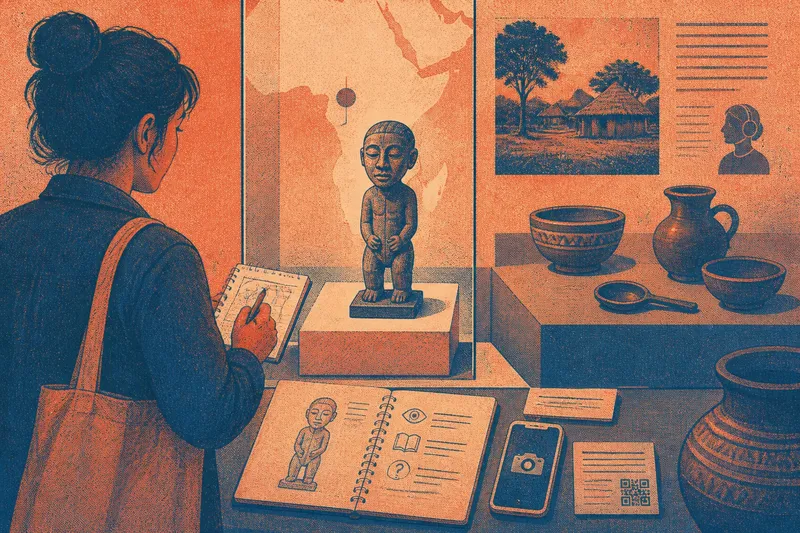
Look for an object with a label you can return to and a clear position in the gallery. Note the name the museum uses, the gallery or case, and one visible feature. A phone note or quick sketch will do; follow the museum’s rules on note-taking and photography.
Say you notice a small carved figure beside several household objects. You write down its label title, the case location and the fact that it is displayed alone on a raised support. You can then compare what the label says with what the display itself emphasises, without assuming the arrangement reflects the figure’s original setting.
What does the display make you notice?
Look beyond the object to its immediate surroundings. Is it isolated, grouped with similar things, or placed beside objects from another place or period? Is the case arranged to suggest a sequence, a contrast or a particular theme? These are choices made for the exhibition, not necessarily a record of how the object was encountered or used before it entered the museum.
Notice the supporting material too: a map, photograph, caption, audio guide or wall text may frame the object differently from its individual label. If a map places it within a region, check whether the text explains what that location represents. The map might indicate where an object was collected, where a maker worked, or simply the area discussed by the exhibition.
Keep a distinction between what you see and what the display suggests. “The figure stands apart from the other objects” is an observation. “It was treated as more important” is an interpretation that would need support from the label or another source.
How do labels shape the story?
Read the title, caption and longer gallery text as parts of an account designed for visitors. A title can make one name seem definitive; a caption can foreground a date or use; the wider text may connect the object to a broader theme. Notice which voices and places are named, and whether the wording signals uncertainty or gives alternative names.
If the museum provides a QR code or online catalogue entry, save the object’s title and catalogue details for later. The longer record may explain how the exhibition’s wording was chosen or supply context not available in the gallery. It may also repeat the same gaps, which is useful to know.
When a label is brief, avoid treating its silence as evidence. A missing maker’s name does not tell you why it is absent, and a single stated use may not describe every role the object has had. Record the exact wording and keep unanswered questions visible in your notes.
What should you check before leaving the gallery?
- Label wording: If the title or caption offers only one name, note it and check the catalogue for alternative names; if none appear, leave the naming question open.
- Gallery location: If you have recorded the case or room, use that detail to find the object again; if not, add the gallery name before moving on.
- Display arrangement: If the object is grouped with others, note the relationship the exhibition presents; if it stands alone, record that without assuming why.
- Supporting material: If a map, photograph or audio guide adds context, note what it clarifies; if it does not explain the object’s connection, do not infer one.
- Uncertainty in the text: If the label uses cautious wording or offers competing accounts, preserve those qualifications; if it states a claim plainly, record it as the museum’s account rather than independent confirmation.
- Follow-up route: If a catalogue link or enquiry contact is provided, save it with your question; if not, note the exact object title so you can search the museum’s collection later.
Which questions help you read the gallery?
Why is an object displayed on its own?
It may be intended to draw attention, allow close viewing or support the exhibition’s theme. The arrangement alone does not establish how the object was valued in its earlier setting.
Does a museum label tell the whole story?
No; a label is a concise account written for a particular display. The catalogue or a later enquiry may add context, while some questions may remain unresolved.
Can neighbouring objects explain one another?
They can suggest a comparison the exhibition wants visitors to make. Check the accompanying text before treating that arrangement as evidence that the objects were historically connected.
What should you do if the wording is unclear?
Note the exact phrase and what you cannot tell from it. A collection record or a specific enquiry to the museum may clarify the point; avoid filling the gap with a guess.
What should you leave open?
Some questions cannot be settled by looking longer at the case. The gallery may not explain how people connected to the object describe it, why a particular name was selected, or how its display might change in another exhibition. Mark these as gaps rather than building a neat story around them. If you contact the museum, ask one specific question and include the object title and catalogue details where available.
Finish your notes with three lines: what the museum says, what you observed in the gallery, and what remains uncertain. A museum visit through one object’s journey becomes easier to recall when the exhibition’s choices are kept distinct from the object’s wider history. That distinction also gives you a useful question for the next room: what has this display made visible, and what has it left outside the case?